


Trigger warning: This article mentions suicide. If you or your loved one need professional help, you may call the National Mental Health Crisis Hotlines: 1553 (Luzon-wide toll-free); 0966-351-4518; 0917-899-8727; 0908-639-2672.
Oftentimes, we overlook the impact of the words we say to others and ourselves.
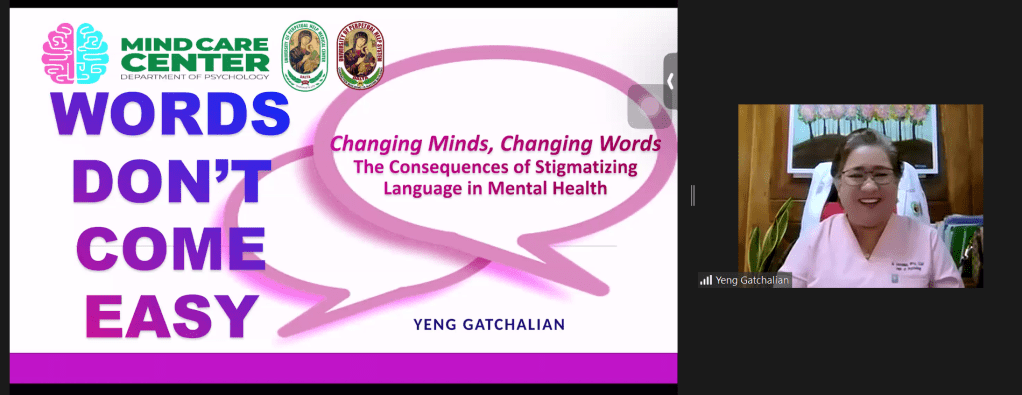
To raise more awareness on the power of words in the context of mental health, Mind Care Center Perpetual Help Medical Center – Las Pinas (Mind Care – PHMC) held a webinar on the consequences of stigmatizing language.
The online session, Words Don’t Come Easy: Changing Minds, Changing Words: The Consequences of Stigmatizing Language in Mental Health, was held Friday in commemoration of the Mental Health Awareness Month, and was participated by around a hundred students, health care professionals, educators, and parents.
Mind Care – PHMC Chief Psychologist Prof. Yeng Gatchalian underscored that words are very potent – they can dissuade someone from seeking much-needed help, promote and perpetuate discrimination, and cause stigma.
“Ang stigma, napaka-powerful niyan para sa isang worth ng isang tao. Meron itong tatlong component: andyan ang tinatawag natin na stereotype. Ito ‘yung paniniwala natin. At dahil sa mga paniniwalang ito, nagko-cause ito ng pakiramdam – prejudice. So, ‘ pag mayroon kang ganitong paniniwala, ito ang nararamdaman mo sa sitwasyon na ‘yun. At dahil ‘yun ang nararamdaman mo, you will act on it – discrimination,” Prof. Gatchalian explained.
She added: “Words can create discrimination if it stigmatizes the person with disability or psychological disorder.”
So how can we prevent stigmatizing language? Here are the do’s and dont’s:
1. Casual and inappropriate use of clinical terms:
- “My pet died. I am depressed”
- “Ang OC mo!” / “OC kasi ako”
- “Ang bipolar ng panahon”
Depression, Obsessive-Compulsive Disorder, and Bipolar Disorders are serious conditions. Prof. Gatchalian cautions against casual use of terms that refer to psychological disorders, and clarifies that only psychiatrists and psychologists may diagnose that someone has depression, OCD, or Bipolar Disorder after appropriate assessment is conducted.
Improper use of clinical terms to describe normal experiences waters down the seriousness of mental health issues and could make people minimize, dismiss, or make fun of these concerns.
Instead of misusing psychological terms, find the right words that describe what you are feeling or experiencing.
2. Using illnesses as adjectives to describe the person:
- Schizophrenic, autistic, diabetic, etc.
“When we say discrimination begins in language, it starts with adjectives,” Prof. Gatchalian warned. She pointed out that using illnesses as adjectives identifies the person with their illness, which is not an accurate way to describe the relationship of a person with their sickness. People live or have conditions or sickness, and people are not their illness.
To address this, use “people-first” language that separates the person from their condition. Instead of saying “schizophrenic,” say: “person with schizophrenia.”
In addition, the word “retarded” is an outdated, pejorative term that was being used many decades ago to describe intellectual disability (ID). It does not accurately capture the nuances of ID so the term should not be used anymore.
3. “Committed suicide”
A person who has reached the point of wanting to end their life is certainly in unimaginable suffering. To say that someone “commits” suicide implies that the person was thinking clearly.
“Many of those who died of suicide, they died not because they wanted to die. Many of them are experiencing severe distress,” Prof. Gatchalian said.
The word commit also connotes doing something illegal, wrongful, or harmful. The continued use of this word to refer to deaths by suicide attributes blame to the person who certainly would be in no way in control of their thoughts or actions anymore. Moreover, to describe a death by suicide as “successful” suggests that suicide was some sort of a goal or something to be achieved.
So, instead of “committed suicide” or “successful suicide,” say: “died of suicide” or “death by suicide.”
4. “Victims” of disaster
People who have gone through disasters, adverse events, or traumatic incidents are called “survivors” instead of “victims.” By referring to them as survivors, their capacity to cope, move ahead, and grow is honored and recognized.
5. Condescending euphemisms such as “differently-abled” or “special”
In avoiding these terms, people can probably learn from journalism, which urges people to “say it as it is.” Using euphemisms like these suggests that the accurate terms to describe what a person is able and not able to do, are offensive. There is nothing offensive, shameful, or wrong about the word “disability” or “disabled.”
6. Associating sexual orientation and gender identity expression with perceived undesirable behavior:
- “Ang lamya mo naman, para kang bakla.”
- “Ang yabang mo ah para kang tibo.”
No need to judge a person’s behavior by making references to one’s SOGIE. Or better yet, let us not judge at all.
7. “Mental illness” as generic / blanket term
Prof. Gatchalian recommends using mental illness in either the plural or singular form. For example, instead of saying: “she has mental illness,” say: “she has a mental illness.” This way, the usage denotes that the person has a particular condition. Moreover, you can say: “people with mental illnesses” instead of “people with mental illness.” This reflects the fact that there are many types of mental illnesses and these are not the same with each other.
When referring to people with mental illnesses, it is not recommended to describe them as afflicted, suffering, or victims. “Itong mga salitang ito, implies a very negative connotation that the person with a mental illness is unhappy or unwell. Hindi po totoo ‘yun. Maraming mga tao na may pinagdadaanan na psychological condition na capable namang maging masaya,” Prof. Gatchalian clarified.
8. When someone you know is going through a difficult time, avoid responding with the following:
- “Me too” / “Ay, relate ako” / “Ako din”
- “Choose to be happy”
- “Ang negative mo” / “Mali ang ginawa mo”
- “Ganito kasi ang gawin mo…”
- Laughing at the person
During the webinar, Prof. Gatchalian urged the attendees to offer support when this happens rather than steer the conversation about themselves.
We should also understand that for people living with psychological disorders, the suffering they go through is not a deliberate choice. It is unhelpful to judge the person or their actions as bad, impose or dictate what the other person should do, or ridicule them.
More helpful responses would be:
- This must be very hard for you / Alam kong hindi madali para sa’yo ang pinagdadaanan mo.
- What can I do to help? / Ano ang maitutulong ko?
- I don’t know very much about that feeling, can you tell me about it? / Hindi ko masyadong gets ang pinagdadaanan mo, pwede mo bang i-kwento?
- I’m here for you. / Andito ako para sa’yo.
- You don’t have to apologize for what you are feeling. / ‘Wag kang mag-sorry dahil sa nararamdaman mo.
- Would you like to see a mental health professional or someone to talk to? / Gusto mo bang magpatingin o may makausap? Tara, punta tayo may kilala akong counsellor.
Indeed, words can impact our views, feelings, and actions. To influence these in a helpful and healthy way, let’s offer hopeful and empowering words to one another.
About the Author

Tricia Zafra, RPsy is the Relationships Editor of Subselfie.com. She’s a journalist, psychologist, university lecturer, and advocacy specialist.
She works as a clinical psychologist at Argao Psych, Mind Care Center – Perpetual Help Medical Center, and Childfam-Possibilities Psychological Services. She also teaches social science at the University of the Philippines Diliman Psychology Department.
Prior to becoming a mental health professional, she had a 12-year career as a broadcast journalist, working as News Correspondent and Anchor for RPN 9 and GMA 7, and as an Executive Producer for CNN Philippines. She transitioned into advocacy communications for Doctors Without Borders – HongKong, and served in the government as the Chief of Public Relations and Information Division of the Philippine Space Agency.
She briefly returned to journalism and took part as lead researcher for the 2023 Media Ownership Monitoring project of VERA Files, German Embassy, and Global Media Registry.
Her volunteer work includes providing peer support to journalists and media workers in distress through the Peace and Conflict Journalism Network Philippines. She also co-authored a mental health handbook for journalists and facilitated mental health sessions.
She’s a vegetarian, painter, licensed scuba diver, and a fur parent.
BA Broadcast Communication 2007 (cum laude), UP Diliman
MA Psychology 2020, UP Diliman
Topnotcher (Rank 2), 2023 Psychologists Licensure Examination




Leave a comment