
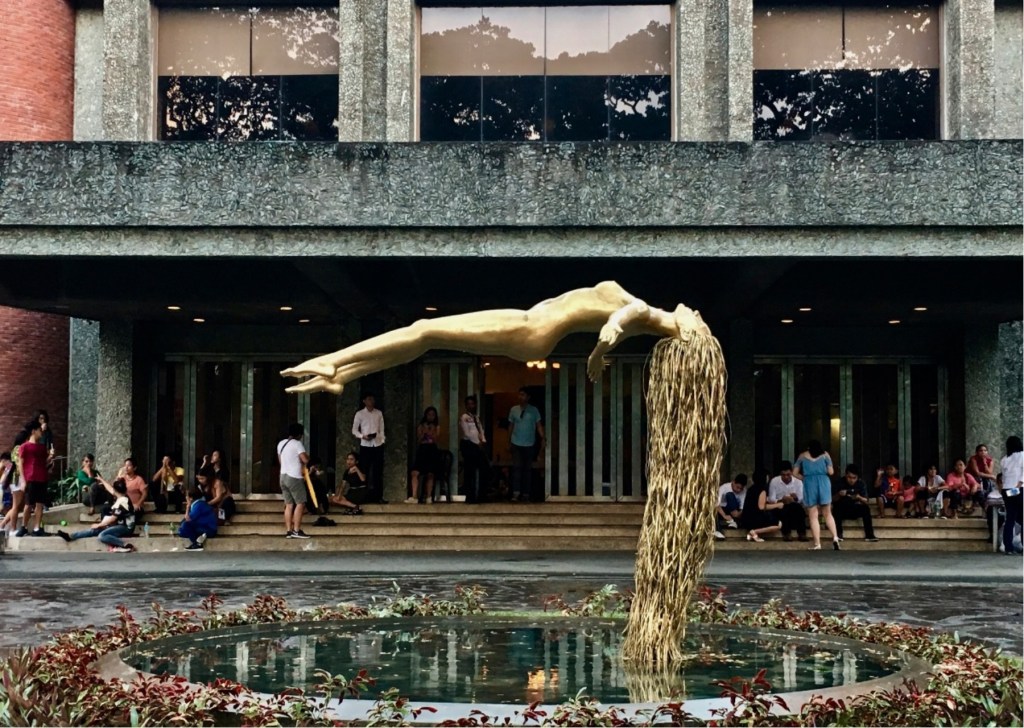

He wasn’t able to sleep the night his masterpiece, “Uplift,” was shown to the public, in front of the University Theater of UP Diliman, during the full bloom of sunflowers along University Avenue, at a celebratory time of commencement exercises.
It wasn’t because of uncontainable sense of achievement that the visual artist was still restless as the long day came to a close, and that finally, after seven years of breathing life to metal, his creation may now lift spirits, evoke feelings, provoke thought, awe, inspire, or be critiqued.
The desired effect was achieved. Many saw the work as the female counterpart of the Oblation statue and instantly understood what the sculpture stood for. But someone noticed something else and pointed out the similarities of the artwork with that of the Virgins of Apeldoorn that has been on public display in the Netherlands since 2001.
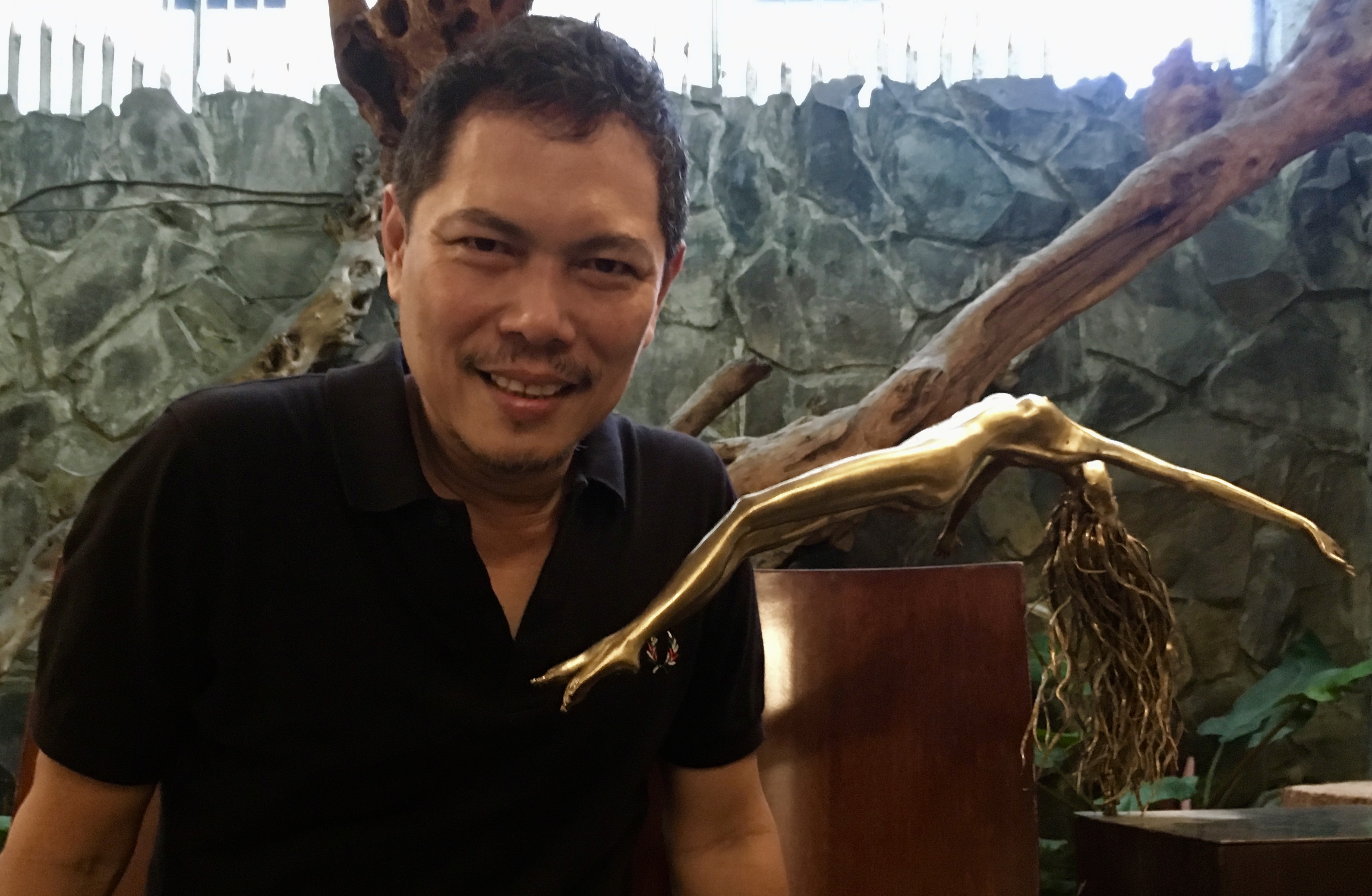
As a visual artist, Ferdie Cacnio says he has always been open to criticism. But for someone who has, all his life, strived for distinctiveness, and who always tells his children, “Huwag kang papasok sa isang bagay na magiging pamparami ka lang,” (don’t enter in any field where you will just become fluff) plagiarism was the most unacceptable controversy he never imagined tainting his reputation.
“Okay lang ako doon sa comparison. Pero ‘yung akusasyon na kinopya ko raw ‘yun, nakakainsulto naman masyado. Kasi sa totoo lang, sinasabi ko na nga hindi ko kilala ‘yung artist. Papaano mo kokopyahin ang isang bagay na hindi mo pa nakikita?” (I’m ok with the comparison. But the accusation that it was copied, that’s very insulting. Actually, I don’t know the artist. How can I copy something I haven’t seen?) Cacnio tells me on a Sunday afternoon, days after his creation blew open debates on art, at least on social media.
Like most artists, Cacnio, born in 1960, learned to draw and mold clay before he could write. The influence could have come from his father, Angel Cacnio, a painter. But it was not until 2005, after 20 years of working as an art broker, layout artist and graphics designer, when the younger Cacnio decided to start a career out of creativity. His inspiration for his first works was his love for dancing during his college days.
“Bakit dancing? Kasi hindi ako marunong kumanta. Sinubukan kong maggitara, masakit sa kamay. Tinanong ko sarili ko, saan ba ako magaling? Movement.” (Why dancing? Because I don’t know how to sing. I tried playing the guitar but it’s painful for my hands. I asked myself where am I good at? Movement.)
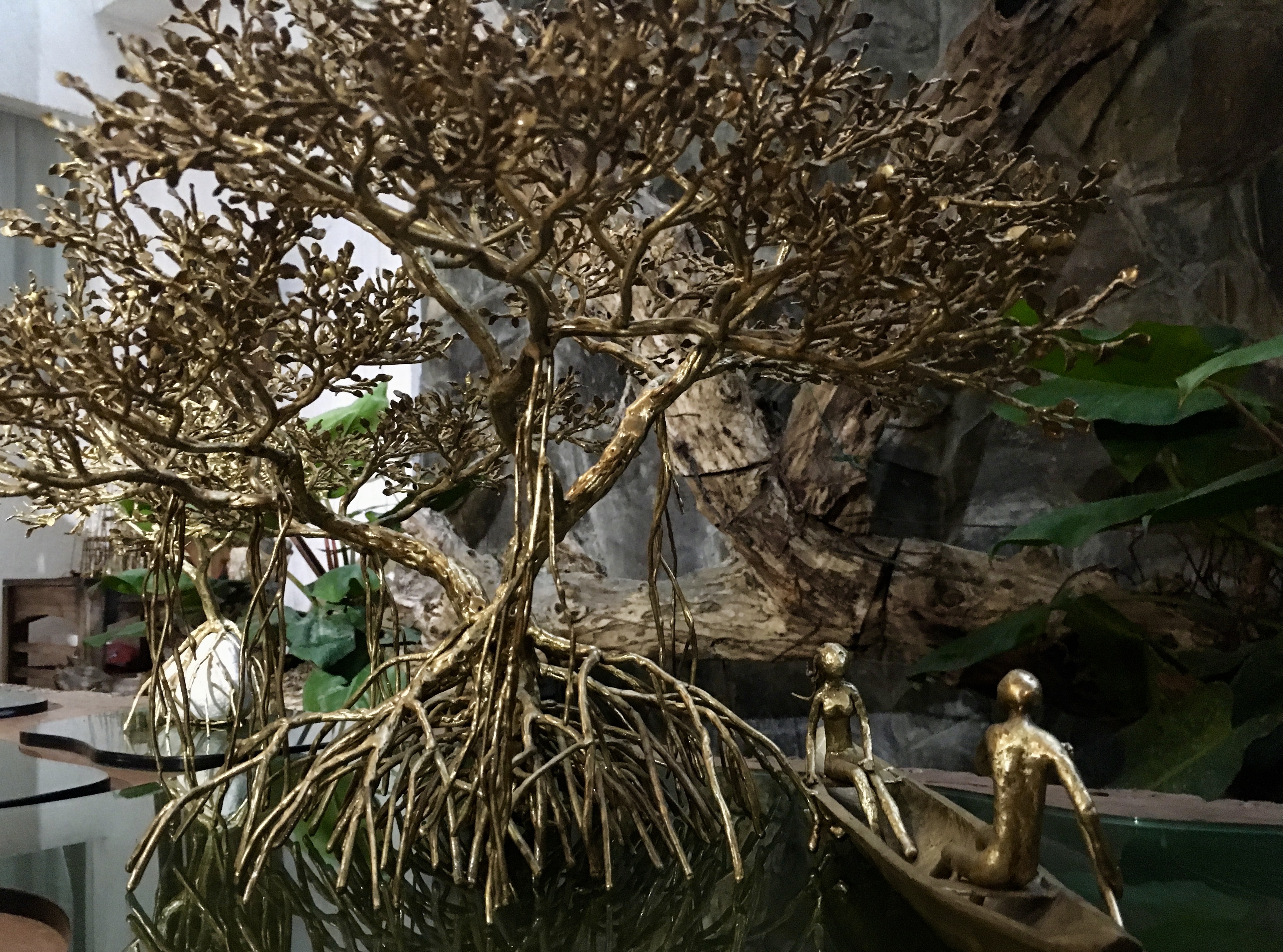
So he manipulated metal, turned them into graceful women, and made them dance after him. Most of his welded brass works depict dancing women that Cacnio made to balance on one foot or by strands of brass hair using his knowledge of engineering. He points out that this consistency can be observed in his works and that this should have been considered by those who have doubted his originality.


“Sana bago sila nag-akusa, nag-research muna ng background ng artist.” (I hope before they accused, they researched the background of the artist first.)
There are two miniature versions of “Uplift” in Cacnio’s living room. One is part of a collection made in 2008 for an exhibit entitled “Levitation.” Cacnio recalls how challenged he felt when he was invited to join the said exhibit and how it compelled him to come up with an idea that he didn’t expect would be used against him later. “Naisip ko, paano ba palulutangin ‘yung katawan. Naisip ko, sa buhok.” (I thought of ways how to make the body float. Then I thought: the hair).
In 2015, Cacnio released 50 replicas of the statue to fund the making of “Uplift,” a project of UP Diliman Civil Engineering batch 1985, which Cacnio is part of. They needed P60,000 to complete the sculpture.

”Uplift,” Cacnio tells me, was heavily-influenced by his life as a student for nine years in UP Diliman, where he finished B.S. in Psychology and B.S. in Civil Engineering in 1981 and 1985, respectively.
”It’s about honor and excellence. Upliftment. Kaya nga ang title ay U-P-lift. Angat. Bakit naka-spread ang arms? Kasi hindi ka aangat kung hindi naka-spread ang arms mo sa mga itinuturo sa’yo.” (That’s why the title is U-P-lift. Levitation. Why are the arms spread? Because you won’t succeed if you don’t open your arms to knowledge.)
Cacnio’s art always imitated his life experiences. When he created a series of brass houses on stilts for an exhibit, he said he thought of life growing up in flood prone Malabon. And when he created brass trees for an exhibit in 2010, he thought of the Narra trees in UP. Indeed, as art imitates life, life enriches art.
As a visual artist, Cacnio says he has to be open to experience, even to unwelcome ones, such as the allegation of plagiarism.
“Life will go on,” he tells me smiling, as if he has already figured out how this experience could, in the future, influence his creations.
[Entry 231, The SubSelfie Blog]
About the Author:
Tricia Zafra is a news Executive Producer. She runs one of CNN Philippines’ evening primetime newscasts, News.PH Kasama si Pia Hontiveros, and recently produced a two-hour breaking news special coverage on the devastation caused by Typhoon Ulysses (Vamco). She had an 11-year career as television reporter and anchor, first at RPN 9, and then at GMA 7. Tricia had also worked in the humanitarian sector as Communications Officer for Médecins Sans Frontières (Doctors without Borders). She’s a vegetarian, painter, scuba diver, and very recently, became a fur parent.
Master’s in Psychology 2020, UP Diliman. Broadcast Journalism 2007 (cum laude), UP Diliman.
Read more of her articles here.





Leave a Reply